Interpreting The Interpreters
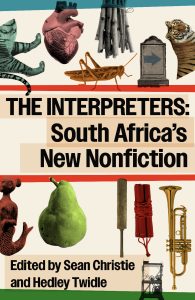
Edited by Capetonians Sean Christie and Hedley Twidle, The Interpreters: South Africa’s New Nonfiction (Soutie Press) is a unique collection of narrative journalism that celebrates – and considers – thirty years of democracy. We get to know the editors, and discover what it took to compile this noteworthy anthology.
What is literary nonfiction?
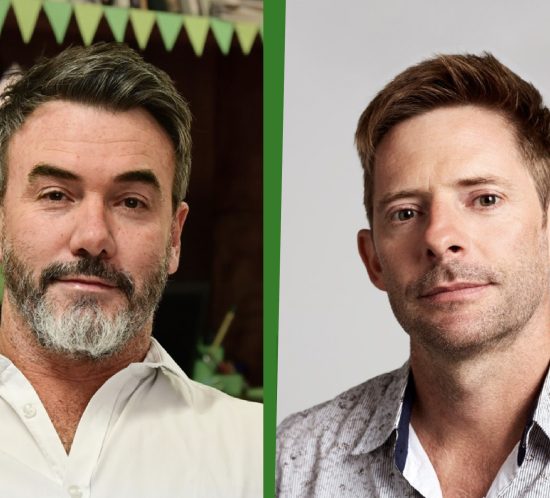
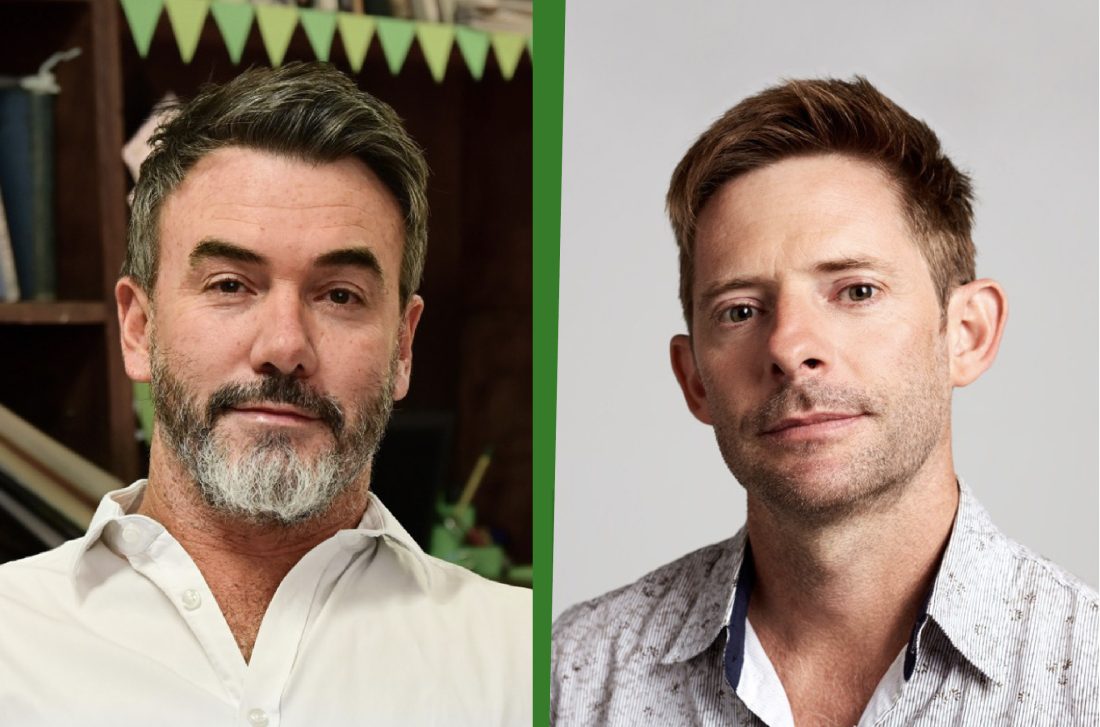
Hedley Twidle (pictured, right): Literary nonfiction is a catch-all term for a range of different writing, and that includes everything from longform journalism, narrative reporting and reportage to essays, memoir, personal narrative, and also profiles and portraits of other people. One of the problems with this field is that there’s no good label for all these different kinds of writing, so you tend to rely on this “non-definition” of nonfiction. The word “literary” is to signal that it’s innovative in some way; nonfiction that is more creative than just a news report or a press release. It’s a work that has its own metaphors, its own attention to voice, perspective, structure, all those good things that make writing alive and interesting.
One good definition of it is Ezra Pound’s definition of literature as “news that stays news”. Why do some pieces still hold charge and energy and excitement, even when the events that they refer to are not topical or current anymore? That is something only time will tell – which pieces of writing will last – and those are the ones we’ve returned to.
Given that Hedley and you are friends, how did the book come to be, and how did you enjoy the process of working alongside one another?
Sean Christie (pictured, left): It has quite a long history. We have been friends since schooldays, and corresponded about books throughout our university years, including an eclectic mix of nonfiction, and I mean super-eclectic: everything from Gaston Bachelard’s Poetics of Space to Deneys Reitz’s Commando. We were into the work of British psychogeographer Iain Sinclair, and his London Orbital, about walking London’s M25, inspired a very precocious decision to move to Cape Town to do something similar with the city’s main road, which runs from the Castle of Good Hope to Simon’s Town. We completely failed to write that book, but we both took the experience of trying to write it into other things: Hedley into his PhD thesis, and I continued to haunt the lower part of the city, and ultimately wrote a book about a community of maritime stowaways living under the foreshore flyovers (Under Nelson Mandela Boulevard). We never imagined we would try and do another book together, but once we started talking about this project it just flowed. Assembling The Interpreters did not feel like work at all, more like the intensification of a long-running conversation. A joy, to be honest.
Why publish now, thirty years into South Africa’s democracy?
Hedley: We felt that it was worth gathering stories around South Africa’s transition to democracy that go beyond the way that that story is told in textbooks, in the global media, in public discourse. In a global context, it’s often the case that societies emerging from troubled, traumatic or repressive pasts produce an outpouring of nonfictional writing. For example, there’s a lot of writing that comes out of Latin America as it emerges from authoritarian rule. There’s a lot of writing that comes out of the collapse of the Soviet Union, which happens pretty much at the same time as South Africa’s transition to democracy.
Narrative nonfiction, the essay, profiles, biographies, memoir – these have been spaces where people reflect on what a sociopolitical transition has meant. It’s where people go to get beyond the 24-hour news stories or the simplistic ways that the story of the “New South Africa” is often produced in the public. There’s been this remarkable flowering of nonfiction writing across the last 30 years.
It’s a bit of a paradox because it is definitely a very South African collection, and the pieces engage that historical, cultural and psychological process of living through these times, but then the pieces are not engaging the big, head-on, overdone, predictable stories that we may get tired of. This “new nonfiction” brings a newness of perception and perspective to the story that we think we know. Big historical events are glimpsed obliquely or in the rearview mirror, with a fresh set of eyes or in an unexpected way.
Lin Sampson’s piece, ‘Now You’ve Gone ‘n Killed Me’ was first published 43 years ago, in 1982. How did you go about selecting entries for the book, and how important was it to you that these spanned multiple decades?
Sean: Lin’s astoundingly good piece about the photographer, bouncer and breker Billy Monk is a bit of an outlier, actually, included simply because it is too good to leave out. We did not set out to collect the best creative nonfiction of all time. For that we would have had to have gone back to the 50s and 60s, when some of the Drum writers were clearly writing under the influence of the American New Journalism, which is the literary movement in which creative nonfiction is most strongly rooted. In the 70s and 80s the local pickings are really slim – there are some good pieces published in the pages of Scope magazine, that scourge of Dopper sensibilities, and Frontline (1978–1991) which was started by Denis Beckett with the lofty aim of bringing an end to apartheid. But the trickle becomes a steadier flow from the mid-90s, when the mainstream newspapers, realising that the traditional hard news approach is not scratching the surface of South Africa’s transition, start commissioning longer pieces by South African writers and thinkers. This, really, is the start of the period we were looking at.
Are there entries in the book that were previously unpublished? If so, what about those pieces left you feeling they deserved publishing?
Hedley: Only Srila Roy’s “Domestic Violence What What” had not been published before. We wanted to include it because it is a very brave account of something that is such an enormous problem in South Africa, domestic violence, and it gave an unusual perspective. Roy is originally from India and had previously done academic work on domestic violence in Kolkata. She then writes a much more personal memoir-style piece about her own experience of this in Johannesburg, but the piece links together these two different cities. She’s brought into contact, in the domestic violence courts, with a woman who’s also a foreigner in South Africa. It is a very layered account of an enormous stain and disgrace and tragedy that is part of the lived experience of so many people in the country.
Both Hedley and you are published writers, yet you’ve taken a considered decision not to include your own pieces in the book. Were you to have included one of your co-editor’s pieces, which would you have selected, and why?
Sean: Hedley’s piece for Harper’s about the theft of Cecil Rhodes’ nose (severed from the bust at Rhodes Memorial with an angle grinder) is everything I look for in creative nonfiction. There is tremendous scholarship behind it, but his touch is so light. It’s the most fantastical detective story, as good as anything you’ll read by SA’s top satirical writers, but it’s true, these things really happened. If Chekov had written longform nonfiction I imagine it would have looked something like Hedley’s “To Spite His Face”. I wish we’d included it, actually. If there’s a deficiency in The Interpreters it’s a deficiency of pieces that make you laugh out loud.
Hedley: Well, I was very sure about that one; I wanted to include a piece by Sean called “Searching for the Soul of the Jukskei”, in which he tries to locate the source of the infamously polluted river in Joburg. He follows the river through the city and through all kinds of different communities. He spends time with men who dredge the water for golf balls. He tries to walk through Dainfern and has a confrontation with the security of that gated community and eventually ends up with a Rastafarian community on the borders of Alexandria. He spends time with people on the total margins of society. It’s a very moving piece, but mainly I’m very sad that we didn’t include it because it’s an incredibly funny piece full of these absurd South African details.
The book includes pieces from some South African greats, including household names like J.M. Coetzee and Antjie Krog. Many of the entries were first published internationally. What’s involved in procuring such pieces?
Sean: By and large the writers of these pieces were incredibly responsive and supportive, and that’s everyone from the Nobel Laureate to the person who has only published one (fantastic) story in her life. Same thing when it came to publisher permissions, not a single barrier was thrown up. It helps that we know a lot of the writers, or know people who know them, but mostly I think authors of this sort of writing have suffered to produce stories that are typically published once, are read by very few people, and then disappear. To see these pieces resurrected, and those efforts recognised, is something that is broadly supported, I think.
Was it a given, from the start, that you’d include four works of graphic nonfiction in the book? You’ve grouped them together – why?
Sean: It was a given. There is a long and rich tradition of graphic literature and cartooning in this country, and it always gets left out of “serious” literary histories and anthologies. The legendary South African cartoonist Andy Mason pointed this out to me in 2016, and I did not want to expand this tradition of neglect. It wasn’t an easy section to put together, however, because quite apart from the complexities of production (which made it necessary to group the pieces), the body of nonfiction pieces is tiny compared to the fiction output, and most of the nonfiction that has been done is memoir, so quite apart from being a graphic nonfiction section, it is also a section of mostly autobiographical pieces.
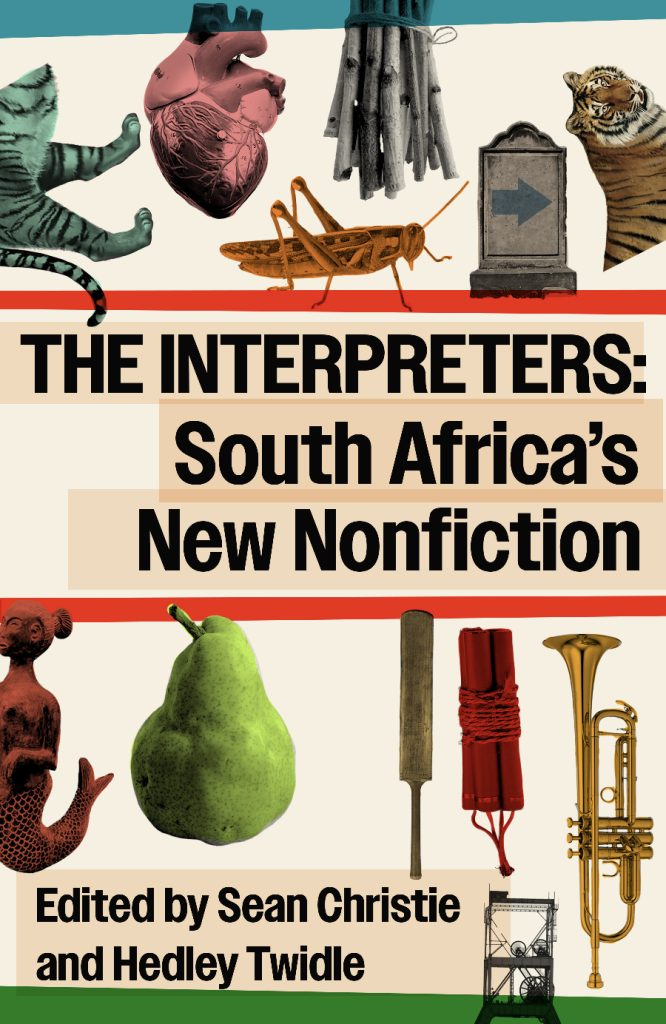
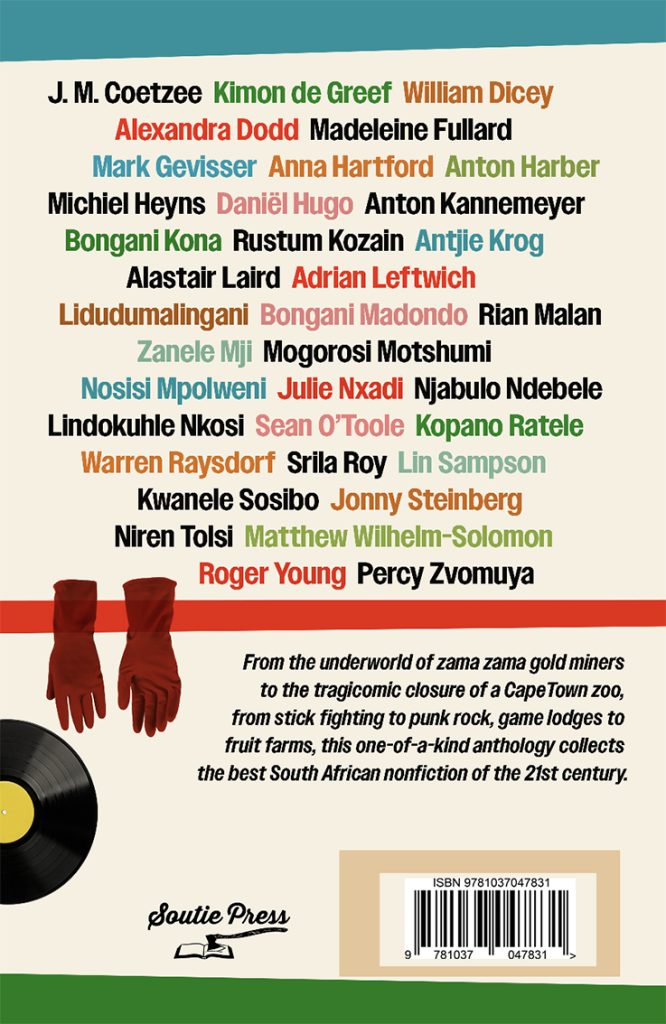
Most refreshing for a South African book, the cover design is of the same high standard as the content. It’s eye-catching, colourful and unexpected; how did this come to be?
Sean: It’s very hard to know whether you’ve nailed a cover until feedback from the reading public (so not friends or family) starts to roll in. This cover took its time to grow on us, which in hindsight was probably a sign that it was getting something right. Of course, we had very little to do with that – our cover artist, Gretchen van der Byl, is an experienced cover designer, but also an art lecturer and keen reader, and just seemed to understand what we, what the book, needed… even when we didn’t necessarily know. She managed to produce something intriguing and inviting, artistic yet commercial. In my experience it always pays off when you trust talented, experienced people to do what they’re good at.
What balance would you say there is in the book between political, cultural and lifestyle pieces?
Hedley: I don’t think those categories are very easy to keep apart. I mean, if I think about Rian Malan’s piece on the song by Solomon Linda, “Mbube”, which becomes Pete Seeger’s “Wimoweh”, which becomes “In the Jungle”, it’s an epic, 12,000-word piece of nonfiction. And yeah, it’s about a song, a cultural expression. But it’s also political because it’s about what happens to African music, and the money made from African music, when it goes global.
We did try and keep a balance. We looked at a balance of place, trying to draw pieces from around the country, not just Joburg and Cape Town; there are also pieces from Zimbabwe. We tried to keep at least some light, amusing pieces – like Michel Heyns’ wonderful memoir of cruising the toilets of Central Cape Town in his youth. I suppose you could call it a lifestyle piece, a kind of lifestyle that is probably unknown to a lot of people.
The most intriguing piece that could have been a classic lifestyle piece but became something more is Sean O’Toole’s “The Closing of the Tygerberg Zoo”. It’s a meditation on our relationship to the natural world. As I said before, news that stays news.
Name a few of your favourite opening paragraphs or lines from the book.
Sean: The Lin Sampson piece starts as well as anything ever written in South Africa. In the version we used it’s the second paragraph, but in other versions it is the opener:
Billy Monk was buried at sea on a thick grey Cape Town day. The sort of day that looks as if it needs to clear its throat. The sea had that chip-chop movement of a child’s drawing, up-down, plip-plop, sick, sick. The movement of the boat was relentless and some people said it was Billy Monk’s last revenge.
Also, the start of Lidudumalingani’s “Fighting Shadows”:
One afternoon my father and the other boys from the Zikhovane village decided to walk across a vast landscape, two valleys and a river, to a village called Qombolo to disrupt a wedding.
And the start of Anna Hartford’s “Unfathomable Life”:
“You shouldn’t think too much about it.” My gynaecologist had always struck me as an under-thinker, but this time I agreed with him. I had overanalysed the question of whether to have a child, and the process had not led to any resolve, only to a knot of fear and uncertainty. Yet when I stepped back everything was quite simple: I loved someone, I wanted his child, I wanted our family.
Hedley: I really love Malan’s beginning to “In the Jungle”, which starts almost like a fairytale.
“A long time ago, a small miracle took place in the brain of a man named Solomon Linda.”
He’s talking about Solomon Linda being in front of a microphone and this melody coming out of his vocal cords, into the mic, pressed into beeswax, becomes a vinyl, gets shipped off to England, becomes a big hit. I love this idea of a small miracle happening in the brain. It’s an unusual metaphor – quite religious but then combined with the brain which is quite secular. It makes me think that all cultural expressions, whether music or writing or art, do begin with a kind of small miracle in the brain, which is ultimately very hard to define or even understand. Also the chain of events. The miracle in the brain, which leads to the activation of the voice and the breath, which leads to the recording, which leads to the beeswax, which leads to the vinyl, which leads to it becoming a hit, which leads to it becoming recorded again and again and again. I like that, those chains of transmission, re-imagination and re-recording and redistribution, which say a lot about how musical history works, how cultural history works, how artistic expression moves across time.
The Interpreters: South Africa’s New Nonfiction is published by Soutie Press. Available now where good books are sold, worldwide in paperback and Kindle formats on Amazon, and directly from www.soutiepress.com.