Thomas Heatherwick’s ingenious Christmas postcards
For over a decade, Heatherwick Studio’s annual Christmas postcards transformed a simple seasonal greeting into a showcase of the studio’s curiosity and inventiveness. With Christmas upon us, we present three of Heatherwick Studio’s designs featured in Thomas Heatherwick Making.
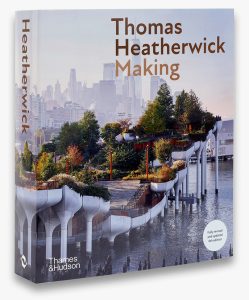
In its early years, Thomas Heatherwick’s studio turned the humble Christmas postcard into an annual act of invention – compact explorations of material, process, and wit delivered as seasonal greetings. Mailed to clients and friends across the UK, each card distilled the studio’s ethos: that any object, no matter how modest, is a chance to rethink how things are made. Engineered pop-outs, tactile constructions, optical illusions, intricate folds, perforations, and discreet mechanical surprises – each December brought a new experiment. With nearly two decades of these cards illustrated and unpacked in Thomas Heatherwick Making (Thames & Hudson), seen together (and alongside over 100 other studio projects) the postcards reveal Heatherwick’s conviction that design is most alive when it feels personal, unexpected, and joyful, even when it arrives through an ordinary letterbox.
1997
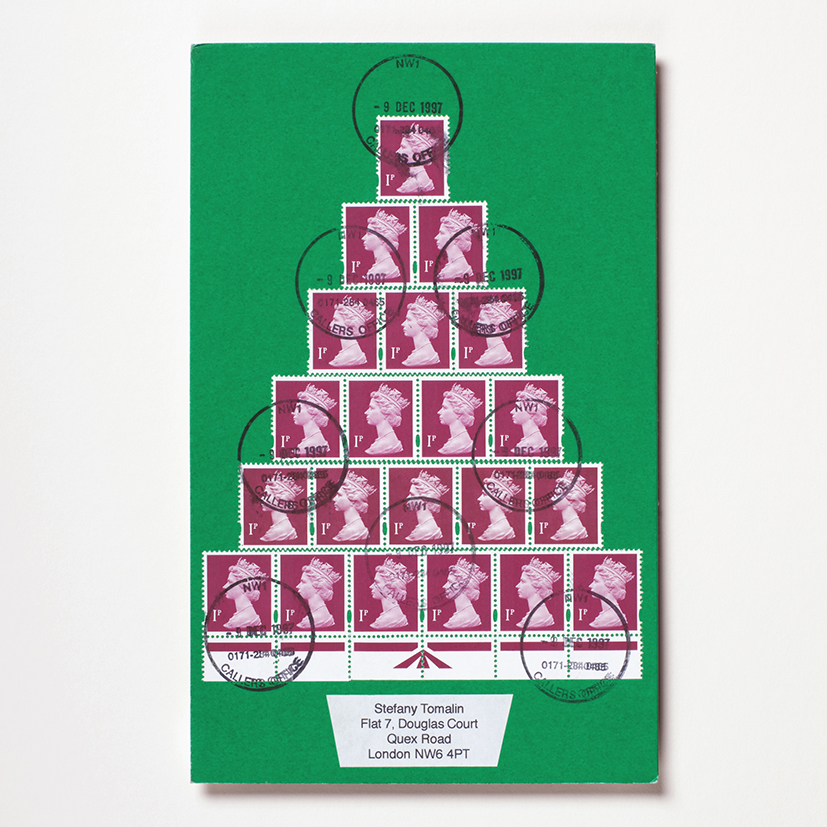
How much work can you get the Post Office to do for 21 pence?
In my first Saturday job, which was in the packing department of a mail order cycling equipment supplier, I was once sent to the nearby post office to buy £2,000 worth of postage stamps. The sheets of tiny rectangles with perforated edges and Queen’s heads on them looked charming and precious and it seemed funny that a sheet of two hundred £5 stamps, worth £1,000, was the same size, had the same high print quality and carried an equal number of Queen’s heads as the sheet of two hundred halfpenny stamps, worth just £1.
Years later, I wondered how the Post Office would react if we used as many stamps as possible on our Christmas cards to make up the value of a second-class stamp, which at that time was 21 pence.
Our idea was to create Christmas imagery by arranging twenty-one one-penny stamps in the shape of a Christmas tree, stuck down on to a piece of card, with the address written at the bottom, as if it was the pot of the tree. As the Post Office has to postmark every stamp with the date and place of posting so that nobody can use it again, the postal workers were forced to decorate our Christmas trees with circular postmarks that looked like Christmas tree baubles. If halfpenny stamps had not already disappeared from circulation, we could have made our trees from twice as many stamps.
2002
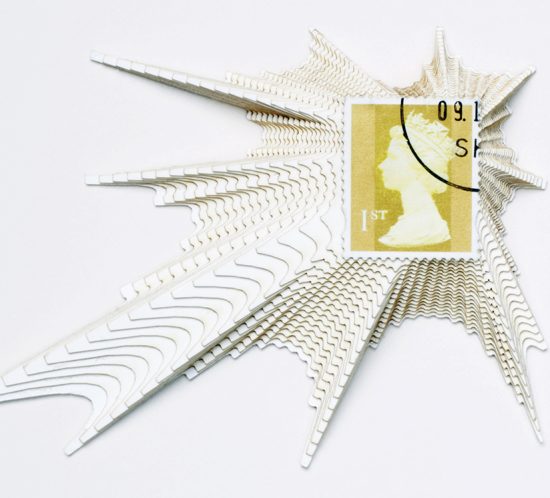
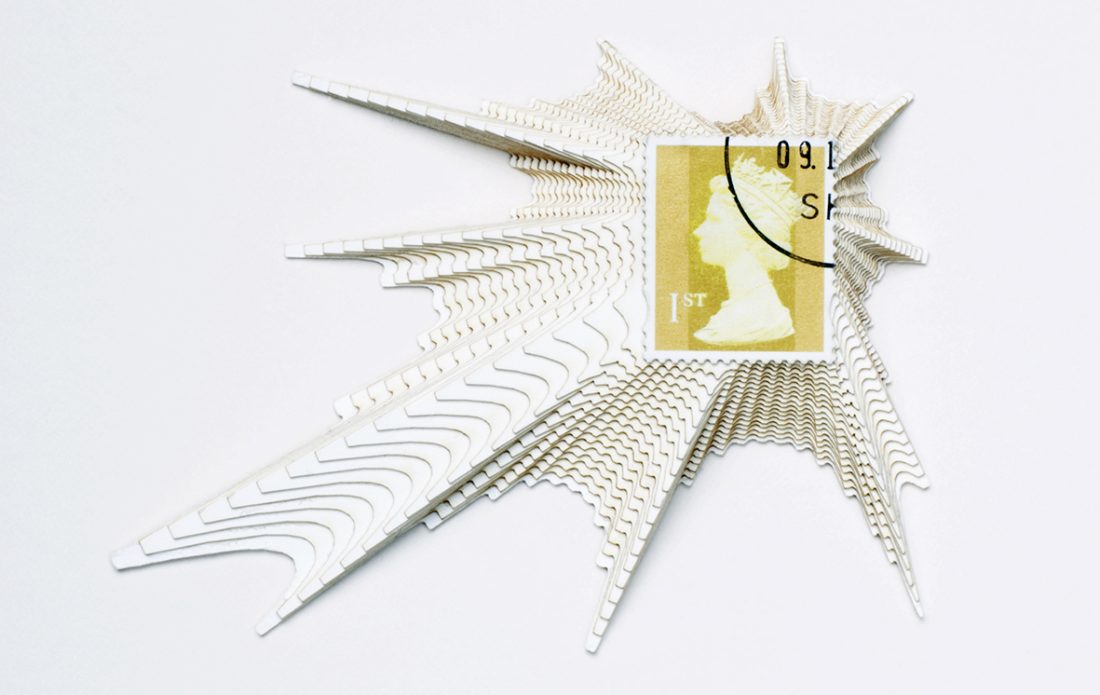
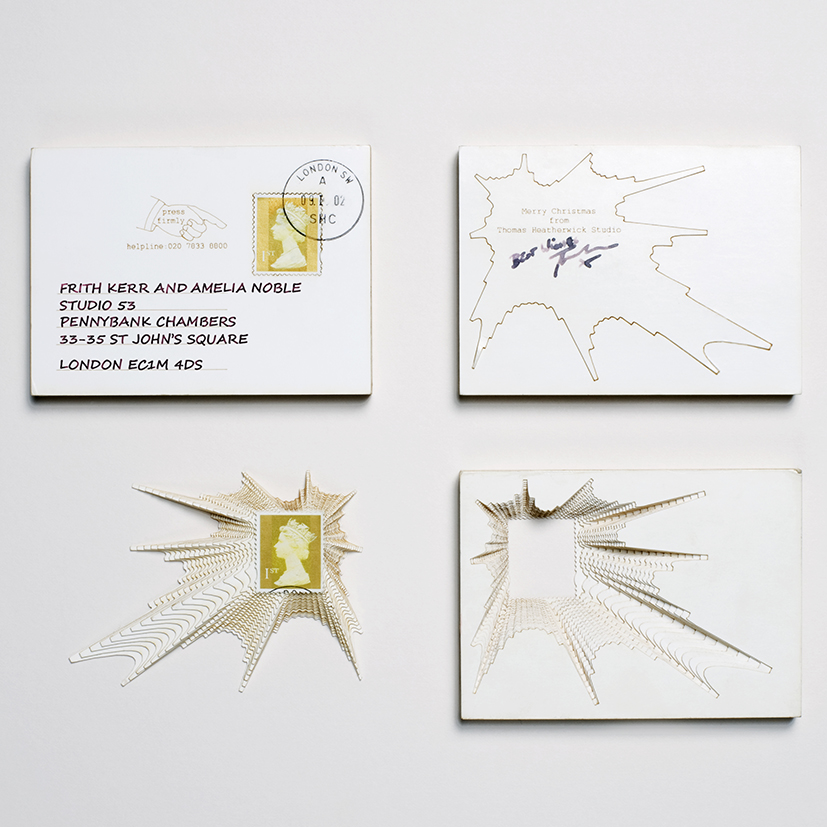
How can a postage stamp become a star?
Wondering what would happen if the tiny perforations around the edge of a postage stamp mutated into something else, we had an idea for a Christmas card that initially appears to be a rectangular block of white cardboard with an address and a stamp on it. Pushing the Queen’s head with your thumb causes the stamp to pop out through the back of the card, exposing a three-dimensional object in the form of an abstracted star, which has been produced by the progressive distortion of the stamp’s perforated edges. Once the card has been broken open, the negative form of the stamp star can be seen embedded in the remaining block. The stamp looks like any other but turns out to be just the top surface of an extroverted object submerged in the card, which is revealed under pressure.
2010
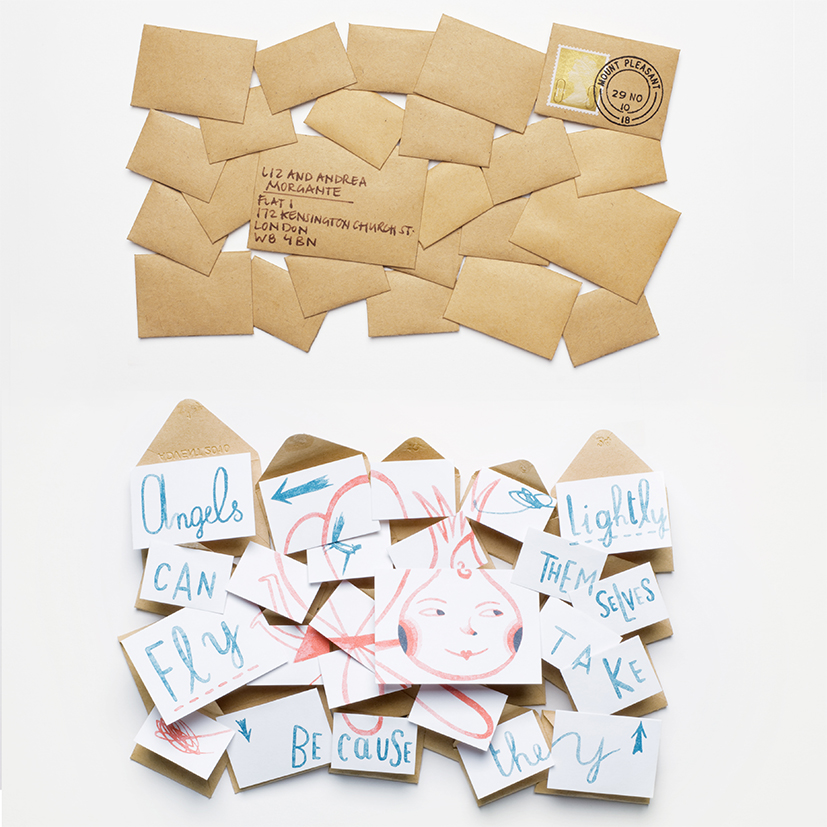
Can you make someone open your Christmas card twenty-four times?
The design of this card is based on the Advent calendars that are given to children at the beginning of December to allow them to count down the days to Christmas Eve. We hoped to recreate the feeling of opening the tiny doors of your Advent calendar to find the coloured picture behind each one.
The card we sent out at the end of November consisted of twenty-four miniature manila envelopes, glued to each other to form an object that was the shape and size of a normal postal envelope and could be posted for the cost of sending a first-class letter. Each day, you opened an envelope and a small card popped out, held by a tiny stalk. The cards appeared to show nothing more than a few letters, a random word or some disconnected lines but, as the month of December went by, they accumulated to reveal an image and caption. The illustrator Sara Fanelli, who we invited to collaborate with us on the content of the envelopes, chose a phrase that was both beautiful and apt, with a final word that was hard to predict until Christmas Eve, when the full picture revealed itself.
Thomas Heatherwick Making is published by Thames & Hudson and is available at leading bookstores.